
 By Joseph Batrin

The test most owners run on AI looks about like this. Open ChatGPT, type a question about your industry, read the answer, close the tab, and decide. Ninety seconds, start to finish, and a verdict on an entire category.
I understand why it happens. For a lot of people the word AI and that one product are the same thing, because it is the one that reached the public first and the one everybody’s nephew told them about.
The Myth
ChatGPT is AI. Whatever it does is what AI does, and whatever it cannot do is what AI cannot do.
The follow up version of that myth is that all of these tools are the same product with different logos on the front, so it does not matter which one you open.
The Reality
Start with the name, because it covers two different things. ChatGPT is the product, meaning the window you type into along with the files, the web search, the image tools and the memory built around it. GPT is the family of models inside that window doing the actual work, and the company adds and swaps those models behind the same window on its own schedule. Keep those two apart and most of what follows makes sense.
ChatGPT is one product, from one company, and it was built to be the generalist. That is a real design decision and not a criticism. It has one of the broadest feature sets of any of them, which means it will read a photograph you hand it, draft a letter, write a spreadsheet formula, make an image, search the web, read a file you hand it and hold a conversation about all of it in the same window.
Breadth is genuinely useful and it is also why the first answer so often feels generic. A tool built to serve everybody knows nothing about your business until you tell it, so it gives you the answer that fits the largest number of people who could have asked that question.
Here is the correction I want to make to my own earlier framing, because I have heard it repeated back to me wrong. That generic first answer is a property of the empty window, not a ceiling on the product. The same product, with your operating documents attached and your standards written down, will do specialist work all day. Generalist describes what it was designed to cover, not what it is capable of once it is loaded.
The other thing worth knowing is that the version most people use is not the version most people are talking about. These companies now ship several models at once behind the same box, some fast and cheap, some slower and far more careful. The default is usually the fast one. The paid tiers put a model picker in front of you, and most people never open it. An owner who tested the fast default on a hard question and came away unimpressed tested the right company and the wrong model.

Why This Costs You
Here is what this actually costs, and it is not the subscription. It is the conclusion. An owner runs the flour test, decides AI is overhyped, and takes the whole category off the table for a year. Meanwhile his competitor down the street is answering after hours calls with it.
The second cost is quieter. Somebody who ran the flour test once will run every job the same way, with the shortest request that could possibly describe it. He will attach a sixty page contract, type summarize this, get back a tidy overview of what any contract like it says, and conclude that AI cannot read contracts. It can. What he needed was the renewal terms, the termination clause and anything that lets the other side raise the price, and he never asked for any of them. The tool answered the question it was given.
A Practical Example
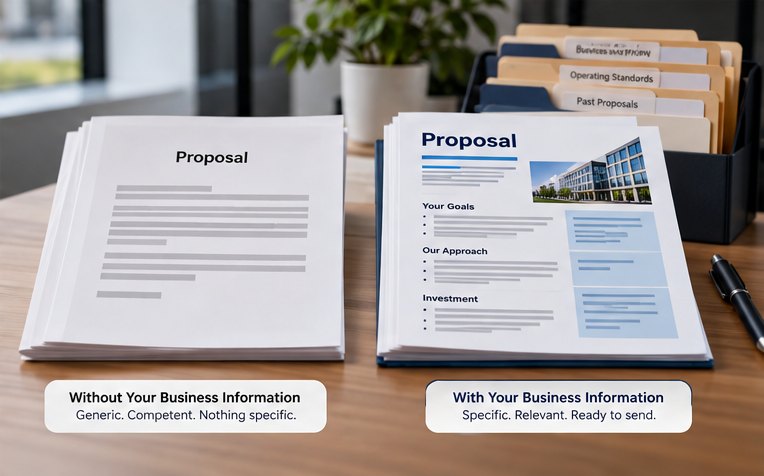
I watched this happen with a proposal in my own shop. The ask was reasonable enough, which was to write a proposal for a client, and the output came back as a competent, hollow template. Correct headings, sensible order, nothing in it that could only have been written about that client.
Nothing malfunctioned. It had been handed a job that requires knowing a business and given no business to know. The same request, made in the same tool, with the operating documents attached and the pricing rules loaded, produced something we could actually send after one pass of edits.
The tool did not get smarter between those two attempts. The input did.
What Actually Works
Use it as the generalist it is. It is the right first stop for drafting, for thinking out loud, for turning a mess of notes into a structure, for quick research you intend to verify, and for image work. It is the tool I would put in front of somebody who has never used any of this, because the surface is broad and forgiving.
Then give it something to work with. Each of the major products has a container built in, called a project or a space or a library depending on who made it, and that container is where your business documents go so they are attached to every conversation instead of pasted in each time. That single step is the difference between the flour test and a real one.
And open the model picker. If you are paying, you have more than one model available and the box does not make a point of telling you. Use the fast one for drafts and quick passes. Switch to the careful one when the job is long, technical, or going in front of a customer. Just know that the careful model cannot supply facts you never gave it. A stronger model without your documents still writes the generic answer, only more slowly.
Do This Today
Open it and make a project for your business. Put one document in it, whatever you already have that describes how you operate, even if it is rough.
Then ask it the same question you asked it cold the first time, and read the two answers next to each other. That comparison is the entire lesson and it takes about ten minutes.