
 By Expand AI Business Solutions
The customer you lose most often isn't the one who says no. It's the one who never reaches a human.
Most service-business owners spend their lead-gen money chasing the wrong end of the funnel. Better SEO. More Google Ads. Another mailer. Bigger truck wraps. The conversation almost never turns to the calls already coming in — and what happens to the ones that don't connect.
The lost calls aren't a number on a spreadsheet. They're moments. Specific moments in a normal week that every owner has lived without noticing. Here are four of them.
10:47 on a Tuesday morning
Your receptionist is on the phone booking a new install. The conversation runs long — homeowner needed to grab their permit paperwork, then their spouse wanted to be on speaker. A second call comes in and rings to voicemail because nobody else is at the desk. A third caller, halfway through dialing, gives up when they hit the same busy line.
You never knew either of them called. The first caller is the one you're focused on. The other two went to the next number on the page.
12:15 on a Wednesday
Your front desk stepped out for lunch. They've earned it. While they're gone, a homeowner whose AC died this morning finally gets a window between her own meetings to make calls. She reaches your voicemail. She doesn't leave a message — most people increasingly don't. She moves on to the next contractor in her saved tabs.
Your desk person walks back in at 1:00. The phone is quiet. They have no idea anyone tried.
6:47 on a Thursday evening
You closed at 5:30. Somebody Googles your trade plus their zip code, taps your number, and reaches the after-hours voicemail recording you've had since 2019. The next contractor down the search results picks up live. By 7:05 they have the job scheduled for first thing in the morning.
That homeowner is now somebody else's repeat customer for the next decade.
A holiday Monday
You took the holiday off. Of course you did — you earned it. While you were grilling, calls stacked up against your line throughout the day. The non-urgent ones leave messages you can return Tuesday. The urgent ones don't wait. By the time you open back up, the jobs that mattered most are already booked with whoever answered.
None of these moments show up in a report.No dashboard flags them. Your team doesn't know they happened. You don't know they happened. The only person who knows is the customer who dialed — and they're already somebody else's customer now.
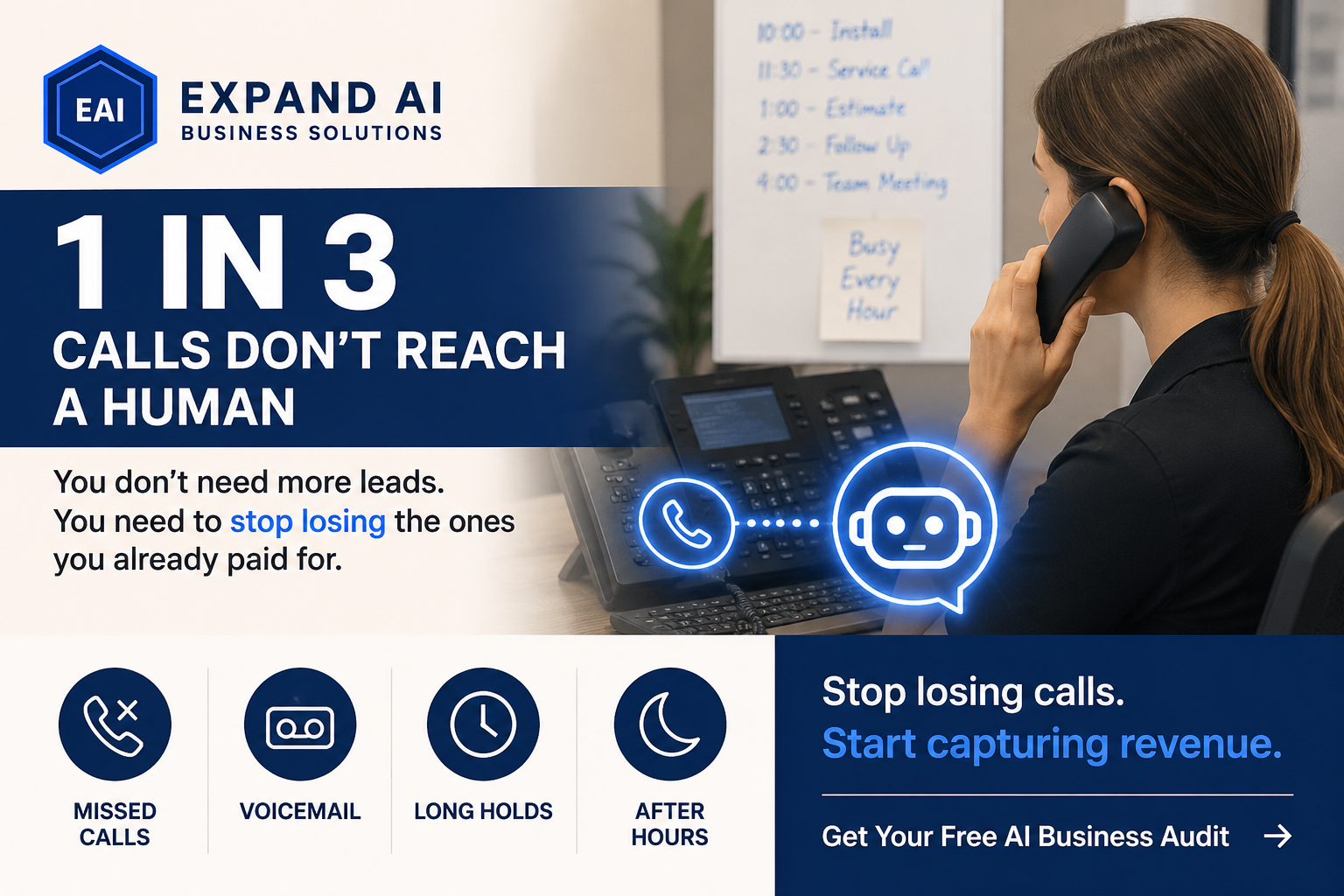
Across the service businesses we audit, roughly one in three inbound calls never reach a human at all. Almost all of that one-in-three lives inside small windows like these — not in a broken sales process or a bad team. In the quiet, ordinary minutes when one human couldn't physically be in two places.
Why hiring doesn't solve it
The instinctive fix is to staff for it. Hire another front-desk person. Add a line. The math never works out. A second receptionist costs $40,000–$60,000 a year fully loaded, and they're still one person who can only handle one call at a time. The third simultaneous call on a Tuesday morning still rings out.
And on a slow Thursday afternoon, you're paying that same person to sit at an empty desk.
How Expand AI Business Solutions fixes it
We install an AI Voice Agent on your business line. It picks up the second and third simultaneous call. It picks up during the lunch hour when nobody's at the desk. It picks up at 6:47 on Thursday. It picks up on holiday Monday. Every caller gets a conversational, qualified intake the moment they dial.
It does what a great receptionist does: greets the caller, identifies the issue, classifies the urgency, captures contact info and address, books the appointment directly on your calendar — or routes the emergency tier straight to your on-call tech's phone. Sends an SMS confirmation before the caller hangs up.
Your front desk keeps doing exactly what they've always done. Nobody loses a job. The AI handles the moments your one human couldn't physically reach. Same team. Same overhead. The calls that were quietly disappearing start showing up on the dispatch board instead.
You don't need more leads. You need to stop losing the ones you already paid for. Same marketing spend. Same crew. More of the jobs already calling in actually become jobs on the board.
If any of those four moments felt familiar — and for most operators at least one of them lands — the problem isn't marketing. It's the small, invisible windows when ready customers reach voicemail instead of a person. The first thing the free AI Business Audit does is map exactly where those windows are in your specific operation, and what the recovered calls would be worth to your business each month.